
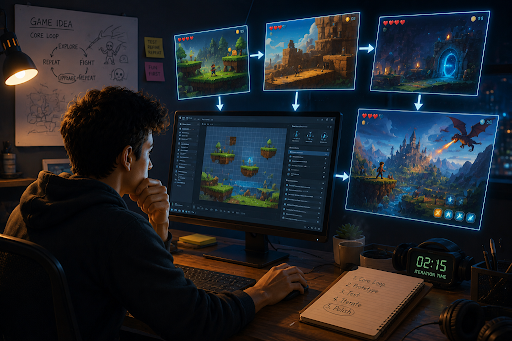
Speed used to be the enemy of quality in game development. Rush a project and it usually showed, in clunky mechanics, unbalanced difficulty, or half-finished systems. AI game makers have complicated that assumption. Speed and quality aren’t automatically in conflict anymore, because the time saved on implementation can go straight back into the parts of development that actually determine whether a game is good.
Here’s how creators are actually using that speed, and how to make sure faster doesn’t quietly become sloppier.
Why Speed Matters More Than It Used To
Ideas Lose Energy the Longer They Sit
Momentum on a creative idea fades fast. The longer the gap between having a concept and seeing a working version of it, the more likely enthusiasm drains before anything gets built. Getting to a playable state quickly protects that initial motivation instead of letting it evaporate during weeks of setup.
Faster Prototyping Means More Ideas Get Tested
When building a rough version takes hours instead of weeks, testing four or five directions before committing to one becomes realistic. That difference alone tends to produce better final decisions, since more genuine comparison happens instead of committing early out of necessity.
The Market Doesn’t Wait
Trends in casual and social gaming move quickly. A concept that would resonate strongly right now might feel dated in six months. Faster development means creators can actually act on timely ideas instead of watching the moment pass while still deep in manual implementation.
Where AI Game Makers Actually Save Time
Turning Descriptions Into Working Prototypes
Game maker online platforms remove the single biggest traditional bottleneck: translating an idea into something playable. Describing a concept in plain language and getting a functioning starting point back compresses what used to take weeks into a single sitting.
Reducing Manual Asset Creation
Generating placeholder or usable assets quickly means layout and pacing can be tested without waiting on a full art pipeline. This matters especially for solo creators and small teams who don’t have a dedicated art department to lean on.
Speeding Up the Testing Cycle
Games like State Conquest reflect what fast, repeated testing can produce, a strategic core loop that feels considered, likely the result of comparing several approaches quickly rather than committing to a single guess and hoping it landed.
Using Saved Time Well, Not Just Fast
Reinvest in Playtesting, Not Just Output
The real advantage of faster development isn’t shipping more content, it’s shipping better-tested content. Time saved on implementation should go toward more rounds of playtesting, not toward rushing straight to a finished product without adequate feedback.
Don’t Skip Refinement Just Because Generation Was Fast
A quickly generated first version is a starting point, not a finished product. Treating speed as permission to skip refinement produces games that feel rushed, even if the underlying mechanic had real potential.
Use Extra Time for Polish That Actually Matters
Controls that feel tight, feedback that lands well, pacing that holds up, these details benefit enormously from deliberate attention. Faster prototyping should free up time for exactly this kind of polish, not replace the need for it.
A Faster Workflow That Still Produces Good Results
1. Define the Core Loop Clearly First
Speed only helps if you know what you’re building toward. A clear one-sentence description of the core action keeps fast generation focused instead of aimless.
2. Generate Multiple Rough Versions Before Choosing
Since each version costs relatively little time, generate a few different approaches to the same core idea and compare them directly, rather than settling on the first one that technically works.
3. Playtest the Rough Version Immediately
Get real reactions to the rough prototype before investing further time. This is where fast generation pays off the most, catching problems while they’re still cheap to fix.
4. Iterate Quickly, But Deliberately
Change one thing at a time and retest, rather than making several adjustments simultaneously and losing track of what actually improved the experience.
5. Slow Down for Final Polish
Once the core loop is confirmed to work, shift pace. Fine-tuning feel, timing, and feedback benefits from careful, unhurried attention, even within an otherwise fast development process.
Common Pitfalls When Prioritizing Speed
Shipping the First Generated Version as Final
The output of an AI game maker is a draft, not a finished product. Skipping refinement because generation felt fast tends to produce games that feel unfinished, regardless of how solid the initial concept was.
Confusing More Output With Better Output
Generating many versions quickly is only useful if it’s paired with genuine comparison and selection. Producing volume without evaluating it critically wastes the speed advantage rather than using it well.
Neglecting Playtesting Because Building Feels Effortless
It’s tempting to keep generating new versions instead of pausing to actually test what you’ve built. Real feedback from real players still matters as much as it always has, regardless of how quickly a prototype came together.
Final Thoughts
AI game makers create games faster, but the real advantage isn’t the raw speed itself. It’s what that speed makes possible: more ideas tested, more feedback gathered, more rounds of refinement fit into the same amount of calendar time. Used well, faster development produces better games, not just quicker ones.
The creators getting the most out of these tools aren’t the ones racing to publish the most content. They’re the ones using the time they save to test more thoroughly and polish more deliberately, which is where speed actually turns into quality instead of just volume.
