
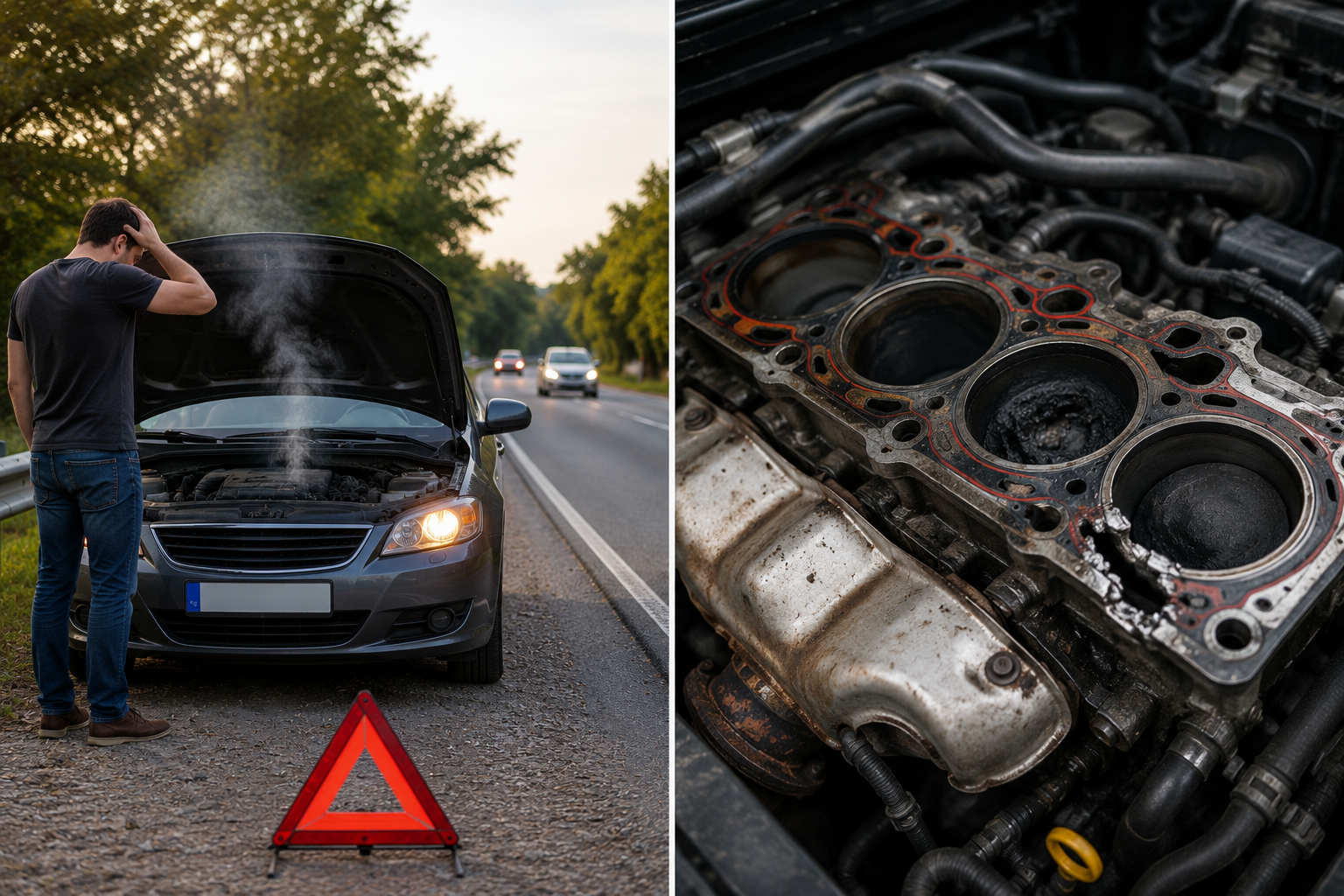
An overheating engine is one of the few car problems you should never ignore. While it may be tempting to drive just a little further to reach home or the nearest garage, continuing to drive with an overheating engine can quickly turn a minor fault into severe and expensive engine damage. Knowing when to stop and what to do next can save you from a costly repair bill.
Your vehicle’s cooling system is designed to keep the engine operating within a safe temperature range. When that system fails, whether because of low coolant, a faulty thermostat, a failing water pump or another issue, temperatures rise rapidly and critical engine components begin to suffer. Even a short journey with the temperature gauge in the red can lead to a blown head gasket, a warped cylinder head or, in extreme cases, complete engine failure.
This guide explains what happens when you keep driving an overheating car, the damage it can cause, the most common reasons engines overheat and the steps you should take to protect both your vehicle and your wallet.
How Your Car’s Cooling System Works
To understand why overheating is so destructive, it helps to understand what is supposed to happen under normal conditions. Your engine generates an enormous amount of heat as a byproduct of burning fuel. Left unmanaged, that heat would destroy the engine within minutes. The cooling system exists specifically to prevent that.
Coolant, a mixture of antifreeze and water, circulates continuously through channels in the engine block and cylinder head, absorbing heat as it goes. It carries that heat to the radiator, where airflow cools the fluid before it loops back around to absorb more heat from the engine. The thermostat regulates this flow, keeping the engine within its optimal operating temperature range, typically around 90 degrees Celsius. The water pump keeps the coolant moving. The radiator fan draws airflow across the radiator when the car is stationary or moving slowly.
When any part of this system fails, heat builds up faster than it can be removed. The temperature gauge rises. And if nothing is done, the consequences escalate quickly.
What Actually Happens When You Keep Driving
The Coolant Boils and Pressure Builds
The first thing that happens when the engine gets too hot is that the coolant begins to boil. Coolant has a higher boiling point than water specifically because of the antifreeze content, but extreme temperatures will overcome that. As the coolant boils, it expands and creates pressure in the cooling system. That pressure pushes against hoses, the radiator, and fittings throughout the system. Weakened hoses can burst. Seals can fail. The pressure cap can give way, venting steam and fluid dramatically.
Once coolant escapes the system, the engine is effectively cooling itself with nothing. From this point, damage accelerates very rapidly.
The Head Gasket Fails
The head gasket sits between the engine block and the cylinder head, sealing the combustion chambers and keeping the oil and coolant channels separate. It is one of the most critical seals in the engine, and it is also one of the most vulnerable to heat damage.
Modern engines typically use aluminium cylinder heads, which are lightweight and efficient but expand significantly when heated. When the engine overheats, the cylinder head expands at a different rate to the engine block beneath it. The head gasket, caught between the two, is subjected to forces it was not designed to withstand. It begins to fail.
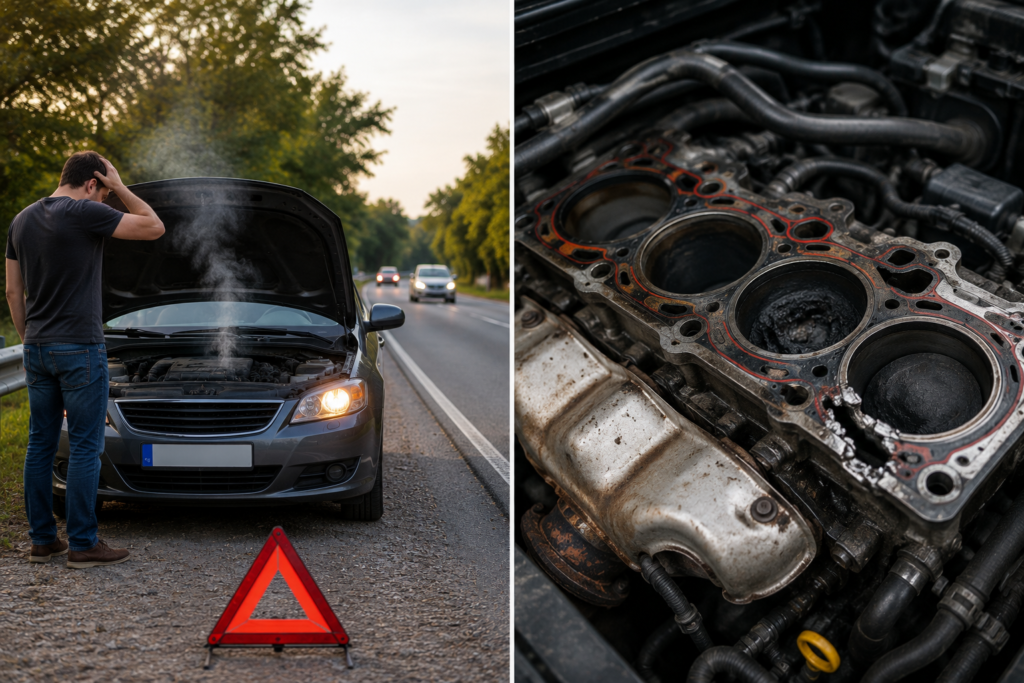
A blown head gasket allows combustion gases to enter the cooling system, coolant to enter the combustion chambers, and in some cases oil and coolant to mix. The symptoms are distinctive: white smoke from the exhaust, a milky contamination visible under the oil cap, unexplained coolant loss, misfiring, and rough running. Head gasket repair in the UK typically costs between £550 and £1,700, depending on the vehicle and the extent of the damage. If the cylinder head has warped, those costs rise considerably.
The Cylinder Head Warps
Aluminium cylinder heads are particularly vulnerable to warping under heat stress. When the engine overheats, the head can distort, losing its flat surface. A warped cylinder head cannot seal properly against the engine block, which means even a new head gasket will fail to hold if the warping is not addressed first.
Fixing a warped cylinder head requires the component to be removed, inspected, and either machined flat, a process called skimming, or replaced entirely if the distortion is too severe. This work typically costs around £800 to £1,200 including removal of the head. If the head is beyond recovery and requires replacement, costs increase further. And all of this is damage that a driver could have avoided by stopping when the temperature gauge first entered the red.
Pistons and Cylinder Walls Are Damaged
As temperatures continue to rise with the engine still running, the pistons inside the engine begin to expand beyond their designed tolerances. Pistons operate within very tight clearances inside the cylinder bores. When they expand too far, they begin to scuff and score the cylinder walls, leaving marks that compromise the engine’s ability to maintain compression. Damaged piston rings allow fuel and combustion gases to bypass into the oil, contaminating it and accelerating further wear throughout the engine.
Engine knock, a pinging or rattling sound caused by fuel combusting prematurely, is another symptom of heat-damaged cylinders and can indicate that the combustion process itself has been disrupted by the temperature spike.
The Engine Seizes
If driving continues despite all the above, the engine will eventually seize. Seizure happens when the heat becomes so extreme that metal components expand to the point where they physically lock together. The pistons fuse to the cylinder walls. Moving parts stop moving. The engine locks solid, often catastrophically and suddenly.
A seized engine is almost always beyond economical repair. In most cases, it means a complete engine replacement, which for many vehicles will cost more than the car is worth. What started as an overheating warning on the dashboard has become a decision about whether to scrap the car.
The Engine Block Cracks
In the most extreme cases, sustained overheating causes the engine block itself to crack. The engine block is the core structural component of the engine, housing the cylinders, pistons, and many of the oil and coolant passages. A cracked block is the most serious possible outcome of overheating and is effectively irreversible without a full engine replacement.
Engine block cracks are rare precisely because most drivers, faced with a rising temperature gauge, steam from the bonnet, and the smell of hot coolant, will stop before reaching this point. But they do happen, and they happen when drivers ignore every warning the car has given them and keep pushing forward.
The Most Common Reasons Engines Overheat
Understanding why an engine overheats helps drivers recognise the warning signs earlier and address problems before they reach crisis point.
Low or Lost Coolant
The most common cause of overheating across UK vehicles is low coolant level. Coolant can be lost through a leak anywhere in the system, from a cracked radiator to a failing hose, a worn water pump seal, or the early stages of a head gasket failure. A sweet smell from the engine bay, puddles of coloured fluid under the car after parking, or a coolant reservoir that needs topping up more frequently than usual are all signs of a cooling system leak that needs investigation.
A Stuck or Faulty Thermostat
The thermostat controls when coolant is allowed to circulate through the engine. When it sticks in the closed position, coolant cannot flow, and the engine temperature rises rapidly even if coolant levels are adequate. A faulty thermostat is a relatively inexpensive component to replace, but the consequences of leaving it unaddressed can be severe.
A Failing Water Pump
The water pump is what physically moves coolant around the system. A pump with a worn impeller, a damaged seal, or a failing bearing gradually loses its ability to circulate coolant effectively. Early signs include a whining or grinding noise from the front of the engine and coolant weeping from the pump housing. Once the pump fails completely, the coolant stops moving and the engine overheats rapidly.
A Blocked or Damaged Radiator
The radiator relies on airflow and the free circulation of coolant to release heat. Blocked fins, internal deposits, or physical damage all reduce the radiator’s effectiveness. Overheating that occurs mainly in slow-moving traffic or when stationary, but improves at higher speeds where airflow increases, often points to a radiator problem.
A Faulty Radiator Fan
At low speeds and when stationary, the radiator fan provides the airflow that the radiator needs to function. If the fan motor fails on an electric system, or the fan clutch fails on a mechanically driven one, the radiator cannot cool the coolant properly when the car is not moving. Overheating in traffic or at idle, which resolves when driving at speed, is a characteristic symptom.
Low Engine Oil
Engine oil does far more than lubricate. It also plays a significant role in managing heat, particularly in areas the coolant cannot reach. Low oil means increased friction and less heat transfer, which raises overall engine temperatures. Consistently low oil, or oil that has degraded and lost its properties through age and use, makes the engine more susceptible to overheating under conditions where a well-maintained car would stay cool.
| Cause | Warning Sign | Action Required |
| Low or lost coolant | Sweet smell, puddles, reservoir emptying | Investigate cooling system for leaks |
| Stuck thermostat | Temperature rises quickly, normal coolant level | Thermostat replacement |
| Failing water pump | Whining noise, coolant weeping from pump | Water pump replacement |
| Blocked radiator | Overheats in traffic, normal at speed | Radiator flush or replacement |
| Faulty radiator fan | Overheats at idle, normal when driving | Fan motor or clutch inspection |
| Low engine oil | Oil warning light, ticking or knocking | Oil top-up and cause investigation |
Warning Signs Your Engine Is Overheating
Engine overheating happens when the temperature of your engine climbs beyond the normal operating range, typically above 105 degrees Celsius, at which point vital components like the cylinder head, gaskets, and pistons can start to warp, crack, or seize. Knowing the warning signs gives you the best chance of catching the problem before lasting damage occurs.
The signs to watch for include:
- The temperature gauge moving into the upper third of its range or toward the red zone
- A dashboard warning light for engine temperature, often appearing as a thermometer symbol
- A sweet, slightly chemical smell entering the cabin through the vents
- Steam or vapour rising from the bonnet or visible in the mirrors
- A sudden drop in engine performance or the car entering a reduced power mode
- Coolant warning light illuminating on the dashboard
- An unusual gurgling or bubbling sound from the engine bay
Any one of these warrants immediate attention. If the temperature gauge reaches the red or steam becomes visible, the situation requires immediate action.
What to Do If Your Car Starts Overheating
Acting quickly and correctly in the first moments of an overheating event can be the difference between a minor repair and a major one.
- Switch off the air conditioning immediately. Air conditioning places extra load on the engine and increases heat output. Turning it off reduces the demand on the system and can slow the temperature rise.
- Turn the cabin heater to its maximum heat setting. This sounds counterintuitive, but the heater draws heat away from the engine through the heater matrix, which acts as a secondary radiator, and expels it into the cabin. Open the windows if the heat becomes uncomfortable. This will not fix the problem, but it can buy you enough time to reach a safe stopping point.
- Find a safe place to stop as soon as possible. Do not try to push on to your destination. A lay-by, a car park, or a quiet side road will do. According to GOV.UK guidance on motorway breakdowns, on a motorway or dual carriageway you should move to the hard shoulder or emergency refuge area, switch on your hazard lights, exit via the left-hand door, and wait well away from traffic.
- Turn the engine off once stationary. Do not leave it running. Allow the engine to cool for a minimum of 30 minutes before opening the bonnet.
- Never open the radiator or coolant cap on a hot engine. The system is under pressure. Opening the cap while hot will cause boiling coolant to spray out with force, causing serious burns. Wait until the engine is fully cool.
- Once cool, check the coolant reservoir. If it is low or empty and you have coolant available, add it slowly to a cold engine only. Never add cold water to a hot engine, as the sudden temperature change can itself cause cracking.
- If the engine continues to overheat after cooling and topping up, do not attempt to drive on. Arrange recovery.
Why Regular Servicing Is the Best Prevention
The vast majority of overheating incidents are preventable. Coolant leaks, failing thermostats, aging water pumps, and blocked radiators are not faults that appear without warning. They develop over time and, with the right maintenance habits, are caught long before they cause a crisis.
A thorough car servicing in Aldershot includes checks of coolant condition and level, inspection of cooling system hoses and connections, assessment of the thermostat and water pump, and a check of the radiator for signs of blockage or damage.
If any of these components are showing signs of wear, they are far cheaper to address during a service than after an overheating incident has already caused secondary damage.
Understanding the difference between a full service and a major service can also help drivers choose the right level of maintenance for their vehicle’s age and mileage.
The automotive industry’s ability to diagnose cooling system problems has also improved significantly in recent years. Modern diagnostic tools can identify failing sensors, track temperature patterns across the engine, and flag developing faults long before they manifest as dashboard warnings.
Coolant: The Most Overlooked Fluid in Your Car
Most drivers check their oil and screen wash regularly. Far fewer pay attention to their coolant. Yet coolant is the fluid that stands between a functioning engine and a seized one when temperatures rise.
Coolant degrades over time. Its ability to prevent corrosion, its freeze protection, and its heat absorption properties all diminish with age. Most manufacturers recommend flushing and replacing coolant every two to five years depending on the type used. Old coolant can also become acidic, which accelerates corrosion inside the cooling system and can cause blockages that restrict flow.
Checking the coolant reservoir is a simple task. The reservoir is a translucent plastic container near the radiator, marked with minimum and maximum lines. The level should sit between these marks when the engine is cold. If it consistently needs topping up, there is a leak somewhere in the system that needs finding and fixing, not just repeatedly filling over.
If your temperature gauge has been rising or your coolant level keeps dropping, the experienced technicians at Ash Road Service Centre can inspect your cooling system and identify the underlying fault before it causes more serious engine damage.
Conclusion
The engine temperature gauge is one of the most important instruments on your dashboard, and it is one of the most frequently ignored. When it moves into the red, your car is not warning you that something might become a problem later. It is telling you that something is wrong right now, and that every additional mile is increasing the cost and complexity of what comes next.
A stuck thermostat addressed during a service costs a fraction of what a blown head gasket costs to repair. A coolant leak caught early is a hose replacement. Left until the engine overheats on the road, it becomes a head gasket, a warped cylinder head, or in the worst case a seized engine. The pattern is consistent: the earlier the intervention, the lower the cost and the simpler the fix.
If your temperature gauge has been behaving unusually, if your coolant level keeps dropping, or if your car simply has not had a cooling system check in some time, do not wait for a warning light or a cloud of steam to prompt you into action. Book a check before the problem decides for you.
If you’re unsure whether it’s safe to continue driving, find Ash Road Service Centre on Google to read customer reviews or arrange a cooling system inspection.
Frequently Asked Questions
How long can you drive an overheating car?
As little as possible. Even a quarter of a mile of driving with an overheating engine can cause significant internal damage, depending on how hot the engine has become and which component has failed. The safest approach is to stop as soon as it is safe to do so and not drive the car again until the cause has been identified and resolved.
Can an overheating engine repair itself?
No. If the engine has overheated due to a failed component such as a thermostat or water pump, that component needs to be replaced. Topping up coolant may allow the car to cool down temporarily, but the underlying fault will cause the problem to recur immediately.
What does a blown head gasket smell like?
A blown head gasket often produces a sweet, slightly chemical smell from the exhaust, caused by coolant being drawn into the combustion chamber and burned with the fuel. White or grey smoke from the exhaust is another common sign, as is a milky, mayonnaise-like contamination visible on the underside of the oil filler cap.
Can I use water instead of coolant if my car overheats?
In an emergency, plain water can be added to a fully cooled engine to get you to a garage. However, water alone does not offer the corrosion protection, freeze protection, or boiling point elevation of a proper coolant mixture. It is a short-term emergency measure only, and the system should be properly flushed and refilled with the correct coolant as soon as possible.
Does overheating affect an MOT?
Indirectly, yes. Engine damage caused by overheating can trigger warning lights, cause emissions failures, and lead to other mechanical faults that would result in an MOT failure.
How much does it cost to fix an overheated engine?
It depends entirely on the damage caused. A failed thermostat or water pump, caught before overheating occurs, is a relatively modest repair. A blown head gasket typically costs between £550 and £1,700 in the UK. A warped cylinder head adds further cost. A seized or cracked engine block, in most cases, means a full engine replacement, which on many vehicles will cost more than the car is worth.
