
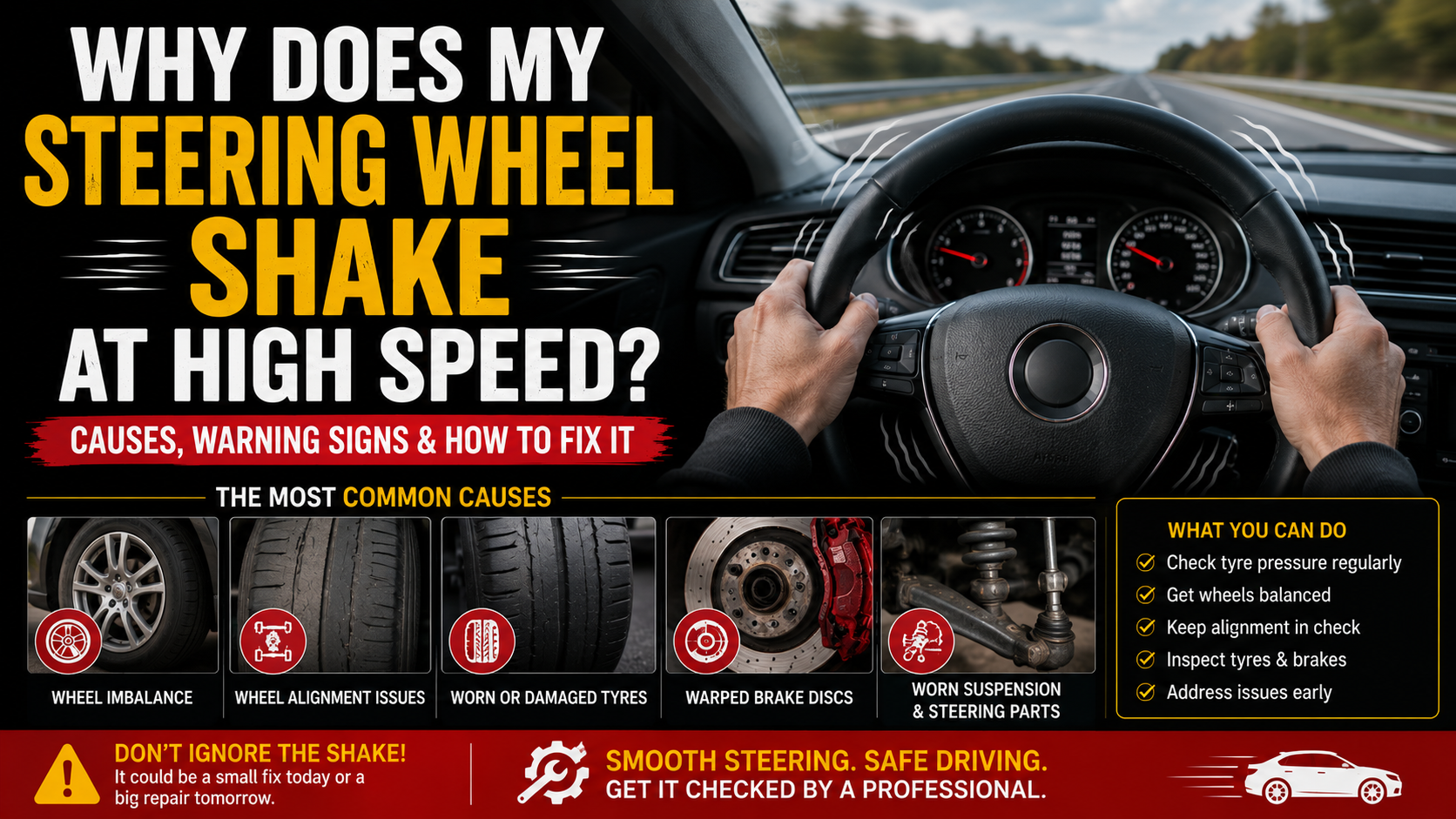
Steering wheel shaking at high speed? Discover the most common causes, from tyre imbalance to brake wear, and how to fix it safely.
There is a particular kind of unease that comes with a steering wheel vibrating in your hands at motorway speed. It is not subtle, and it is not something most drivers can comfortably ignore. Unlike a warning light that can be glanced at and dismissed, a shaking wheel is felt directly, which is exactly why it tends to prompt an immediate search for answers.
The good news is that this is one of the more diagnosable car problems. Steering vibration almost always points to a small number of likely causes, and most of them are straightforward to identify and fix once the pattern of the shake is understood.
Why Speed Makes a Difference
Steering vibration that only appears at higher speeds, rather than at all times, is a useful clue in itself. Many of the underlying causes involve rotational imbalance or wear that becomes more pronounced as wheel speed increases. At lower speeds, the forces involved are simply too small to produce a noticeable shake. Once a car reaches motorway speed, even a slight imbalance can translate into a wheel that visibly vibrates.
This is why a car can feel completely normal around town, only to develop an unmistakable shake once it reaches 60 or 70 miles per hour.
The Most Common Cause: Wheel Imbalance
Wheel imbalance is, by a wide margin, the most frequent reason drivers experience steering wheel shake at speed. Every wheel and tyre assembly needs to be evenly weighted around its axis. Even a small amount of uneven weight distribution, often just a few grams, can cause a wheel to vibrate as it spins faster.
This imbalance can develop from:
- Uneven tyre wear over time
- A wheel weight that has fallen off or was never correctly fitted
- A new tyre that has not been properly balanced during fitting
The fix is usually simple and inexpensive. If your steering wheel vibrates mainly at motorway speeds, a professional wheel balancing service can quickly identify and correct uneven weight distribution before it causes premature tyre wear or suspension damage. It’s also worth understanding the difference between wheel balancing and wheel alignment, as the two services solve different problems.
Wheel Alignment Issues
While often confused with balancing, alignment is a separate issue entirely. Alignment refers to the angles at which the wheels meet the road, rather than how evenly weighted they are. Poor alignment tends to produce a slightly different symptom pattern.
Signs that point toward alignment rather than balance include:
- The car pulling gently to one side, even on a flat, straight road
- Uneven tyre wear across the width of the tread
- A steering wheel that sits off centre when driving straight
- Vibration that feels more like a pull than a pure shake
Alignment issues typically develop after hitting a pothole, kerb, or similar impact. Left uncorrected, poor alignment accelerates tyre wear considerably, which makes addressing it early a sensible way to protect a more expensive investment down the line.
Worn or Damaged Tyres
Beyond balance and alignment, the physical condition of the tyre itself can cause vibration. A tyre with uneven tread wear, a bulge in the sidewall, or internal damage from a pothole strike will not roll consistently, and that inconsistency is felt directly through the steering wheel.
Look for:
- Patches of tread that appear more worn than the rest of the tyre
- Visible bulges or lumps on the sidewall
- Flat spots, particularly on a car that has been parked for a long period
A damaged tyre showing any of these signs should be inspected promptly, since continuing to drive on it, particularly at speed, carries a real safety risk.
Brake Related Vibration
Not all steering shake originates from the tyres. Warped brake discs are a common cause of vibration, though this tends to present slightly differently. Brake related shake is usually felt most strongly when braking, particularly from higher speeds, rather than as a constant vibration throughout the drive.
Discs can warp due to:
- Repeated heavy braking, particularly on long descents
- Age related wear combined with heat cycling
- A disc that was already close to its minimum thickness
Because brakes are a critical safety component, any vibration felt specifically during braking should be treated with priority. Understanding how often brakes should be inspected is a useful starting point for drivers unsure whether their brakes are due a check, particularly if the vibration has developed gradually rather than appearing suddenly.
Suspension and Steering Component Wear
Less commonly, but still worth ruling out, worn suspension or steering components can contribute to a shaking sensation at speed. Components such as wheel bearings, tie rod ends, or control arm bushes naturally wear over time, and as they loosen, they can introduce play that becomes noticeable as vibration.
A worn wheel bearing, for example, often produces a humming or grinding noise alongside the vibration, which helps distinguish it from a simple balance issue. This type of wear tends to worsen gradually, making early diagnosis important before it affects handling more broadly.
A Quick Comparison of Likely Causes
| Symptom pattern | Most likely cause | Typically felt |
| Vibration only at higher speeds, no pulling | Wheel imbalance | Through the steering wheel |
| Vibration with the car pulling to one side | Wheel alignment | Through the wheel and the car’s direction |
| Vibration only when braking | Warped brake discs | Through the pedal and wheel together |
| Vibration with a humming or grinding noise | Worn wheel bearing | Through the wheel and floor |
| Vibration alongside visible tyre damage | Tyre wear or damage | Constant, worsening with speed |
What Drivers Commonly Report
Across driver forums and social media discussions, steering vibration is one of the most frequently raised concerns, largely because it is so noticeable and unsettling. A common pattern involves drivers noticing a slight shake shortly after fitting new tyres, later discovering the wheels had not been balanced correctly during installation.
Others describe vibration appearing gradually after hitting a pothole, only realising weeks later that the impact had knocked the wheel alignment out slightly. A frequent piece of advice shared within these communities is to address vibration as soon as it appears, since continuing to drive on an imbalanced wheel accelerates tyre wear and can place additional strain on suspension components.
When to Get It Checked Immediately
While some vibration issues are more of an inconvenience than a danger, certain warning signs mean a car should be checked as soon as possible rather than left for a routine appointment.
- A vibration that becomes suddenly worse, rather than gradually
- Vibration accompanied by a pulling sensation strong enough to affect control
- Any grinding or knocking noise alongside the shake
- Vibration that intensifies specifically under braking
These patterns suggest the issue may involve safety critical components, and prompt inspection is the sensible course of action.
How This Gets Diagnosed and Fixed
Most causes of steering vibration are identified fairly quickly through a combination of visual inspection and specialist equipment. Wheels can be tested on a balancing machine, which identifies exactly where extra weight is needed. Alignment is checked using laser guided equipment that measures the angles of each wheel precisely against manufacturer specifications.
This kind of check is often included as part of routine car servicing, and similar inspections form part of what gets assessed during an MOT test in Aldershot, particularly around tyre condition and steering components. Catching these issues during a scheduled check is one of the simplest ways to avoid vibration developing into a larger problem.
What Happens If You Ignore the Vibration
It can be tempting to adjust to a shaking steering wheel, especially if it only appears occasionally or seems to settle down at certain speeds. Many drivers describe getting used to it over a few weeks, telling themselves it is simply how the car feels now. This adjustment, while understandable, tends to mask a problem that is quietly getting worse rather than staying the same.
An imbalanced wheel left unaddressed does not just remain a mild annoyance. The uneven weight distribution continues to place extra stress on the tyre, the wheel bearing, and the suspension components connected to it. Over time, this can accelerate tyre wear unevenly, shorten the lifespan of suspension parts, and in some cases lead to a wheel bearing failing entirely, which is a far more involved and disruptive repair than a simple rebalance would have been.
Alignment issues follow a similar pattern. A wheel sitting slightly out of position continues to drag against the road at an incorrect angle every single mile the car is driven. What starts as faster wear on one edge of a tyre can, over several months, mean replacing that tyre years earlier than necessary, along with placing uneven strain on the opposite side of the suspension as it compensates.
There is also a safety dimension worth taking seriously. A car that vibrates or pulls unpredictably responds less precisely when quick reactions matter most, whether that is an emergency stop or a sudden need to change lane. A shake that feels manageable on a familiar road can feel very different in poor weather, heavy traffic, or an unexpected hazard. Treating vibration as background noise rather than a signal worth acting on is where a manageable fix quietly turns into a more serious one.
Whether the cause is tyre imbalance, worn brakes, suspension wear, or wheel alignment, regular maintenance from experienced technicians helps keep your vehicle safe and comfortable to drive. Learn more about the complete range of vehicle maintenance services available at GForce Tyres Aldershot.
Final Thoughts
A shaking steering wheel is rarely a mystery once it is looked at properly, but it is also not something to leave to chance. Unlike faults that whisper through a faint smell or a light that flickers and disappears, vibration makes itself known clearly and immediately, which means drivers already have the most important piece of information they need, that something is off and worth investigating.
What matters most from here is not panicking, but paying attention to the pattern. Whether the shake appears constantly, only under braking, or alongside a pull to one side, that detail alone points toward the most likely cause and the most sensible next step. Wheel imbalance and alignment issues make up the vast majority of cases, and both are quick, affordable problems to resolve when caught early.
For drivers across Aldershot, Farnborough, Fleet, Farnham, Ash Vale, Tongham, and North Camp, the real lesson here is one of timing. A vibration investigated within the first week or two is almost always a straightforward fix. The same vibration left for months, adapted to and driven around, tends to bring in additional wear, additional cost, and additional risk that never needed to be part of the story. A steering wheel that shakes is a car asking for five minutes of attention, and it is always worth giving it exactly that.
Frequently Asked Questions
Is it safe to keep driving with a shaking steering wheel?
It depends on the severity. A mild vibration at speed is usually safe to drive cautiously to a garage, but strong shaking, pulling, or noise should be treated as a reason to stop and have the car inspected before continuing.
Can new tyres cause steering wheel shake?
Yes, if they were not balanced correctly during fitting. This is one of the more common causes of vibration shortly after a tyre replacement.
Does hitting a pothole always cause alignment problems?
Not always, but a firm impact is one of the most common causes of alignment issues, particularly if the vibration or pulling sensation appears shortly afterwards.
How do I know if it’s my brakes causing the shake?
Brake related vibration is usually felt specifically when braking, often through the pedal as well as the steering wheel, rather than as a constant shake throughout the drive.
Can worn suspension parts cause steering vibration?
Yes. Components such as wheel bearings or tie rod ends can introduce vibration as they wear, often alongside a noise such as humming or grinding.
